



AE Principles: International standard
The 13 principles of Agroecology
Agroecology is a dynamic concept that has gained prominence in scientific, agricultural and political discourse in recent years. It is increasingly promoted as being able to contribute to transforming food systems by applying ecological principles to agriculture and ensuring a regenerative use of natural resources and ecosystem services while also addressing the need for socially equitable food systems within which people can exercise choice over what they eat and how and where it is produced.
Agroecology embraces a science, a set of practices and a social movement and has evolved over recent decades to expand in scope from a focus on fields and farms to encompass whole agriculture and food systems. It now represents a transdisciplinary field that includes all the ecological, sociocultural, technological, economic and political dimensions of food systems, from production to consumption.
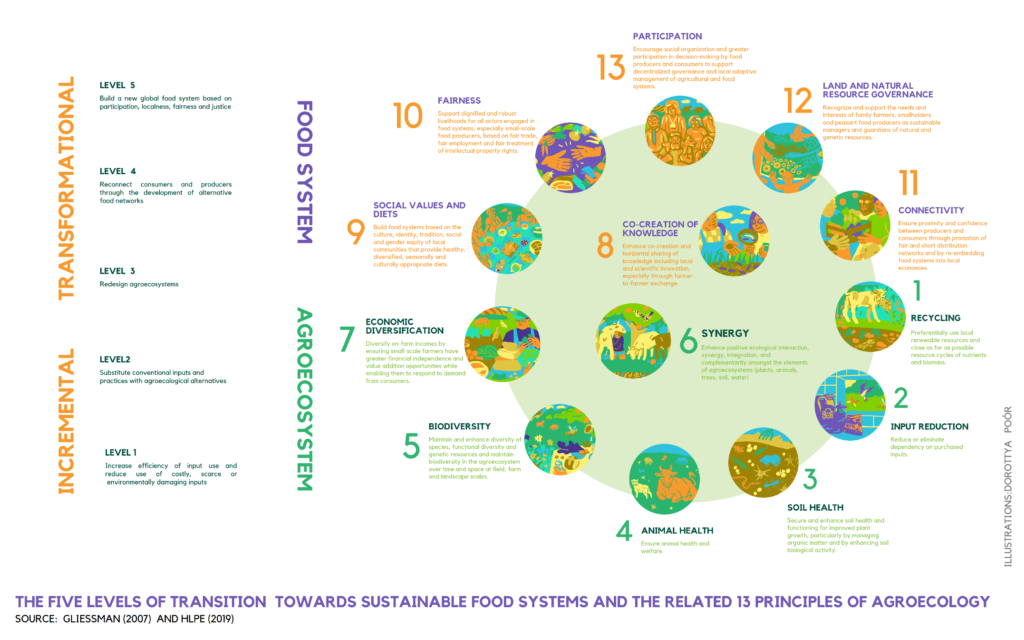
Defined 13 principles of agroecology
In 2019, the High-Level Panel of Experts on Food Security and Nutrition (HLPE)—the independent body of the United Nations Committee on World Food Security (CFS)—defined 13 principles of agroecology in the report titled “Agroecological and other innovative approaches for sustainable agriculture and food systems that enhance food security and nutrition” as a framework for sustainable agriculture and transformation of food systems. Since their introduction, the HLPE 13 principles of agroecology have gained recognition and have been widely referenced in discussions and initiatives related to sustainable agriculture, food security, and environmental sustainability. They provide a holistic framework for promoting agroecological approaches to agriculture and food production that improve sustainability/efficiency, resilience, and social equity.
The definitions utilized in this pamphlet are taken directly from:
HLPE. 2019. Agroecological and other innovative approaches for sustainable agriculture and food systems that enhance food security and nutrition. A report by the High Level Panel of Experts on Food Security and Nutrition of the Committee on World Food Security, Rome.
RECYCLING
RECYCLING
Preferentially use local renewable resources and close as far as possible resource cycles of nutrients and biomass. [Improve resource efficiency]
Scale application: Field, Farm
INPUT REDUCTION
INPUT REDUCTION
Reduce or eliminate dependency on purchased inputs and increase self-sufficiency. [Improve resource efficiency]
Scale application: Farm, Food system
SOIL HEALTH
SOIL HEALTH
Secure and enhance soil health and functioning for improved plant growth, particularly by managing organic matter and enhancing soil biological activity.
[Strengthen resilience]
Scale application: Field
ANIMAL HEALTH
ANIMAL HEALTH
Ensure animal health and welfare. [Improve resource efficiency]
Scale application: Field, Farm
BIODIVERSITY
BIODIVERSITY
Maintain and enhance diversity of species, functional diversity and genetic resources and thereby maintain overall agroecosystem biodiversity in time and space at field, farm and landscape scales. [Strengthen resilience]
Scale application: Field, Farm
SYNERGY
SYNERGY
Enhance positive ecological interaction, synergy, integration and complementarity among the elements of agroecosystems (animals, crops, trees, soil and water). [Strengthen resilience]
Scale application: Field, Farm
ECONOMIC DIVERSIFICATION
ECONOMIC DIVERSIFICATION
Diversify on-farm incomes by ensuring that small-scale farmers have greater financial independence and value addition opportunities while enabling them to respond to demand from consumers. [Strengthen resilience]
Scale application: Field, Food system
CO-CREATION OF KNOWLEDGE
CO-CREATION OF KNOWLEDGE
Enhance co-creation and horizontal sharing of knowledge including local and scientific innovation, especially through farmer-to-farmer exchange. [Secure social equity/responsibility]
Scale application: Farm, Food system
SOCIAL VALUES & DIETS
SOCIAL VALUES & DIETS
Build food systems based on the culture, identity, tradition, social and gender equity of local communities that provide healthy, diversified, seasonally and culturally appropriate diets. [Secure social equity/responsibility]
Scale application: Field, Food system
FAIRNESS
FAIRNESS
Support dignified and robust livelihoods for all actors engaged in food systems, especially small-scale food producers, based on fair trade, fair employment and fair treatment of intellectual property rights. [Secure social equity/responsibility]
Scale application: Farm, Food system
CONNECTIVITY
CONNECTIVITY
Ensure proximity and confidence between producersand consumers through promotion of fair and short distribution networks and by re-embedding food systems into local economies. [Secure social equity/responsibility]
Scale application: Farm
LAND AND NATURAL RESOURCE GOVERNANCE
LAND AND NATURAL RESOURCE GOVERNANCE
Strengthen institutional arrangements to improve, including the recognition and support of family farmers, smallholders and peasant food producers as sustainable managers of natural and genetic resources. [Secure social equity/responsibility]
Scale application: Farm, Food system
PARTICIPATION
PARTICIPATION
Encourage social organization and greater participation in decision-making by food producers and consumers to support decentralized governance and local adaptive management of agricultural and food systems [Secure social equity/responsibility]
Scale application: Food system