



Bridging Theory and Practice: Agroecology Students Dive into Conservation Agriculture
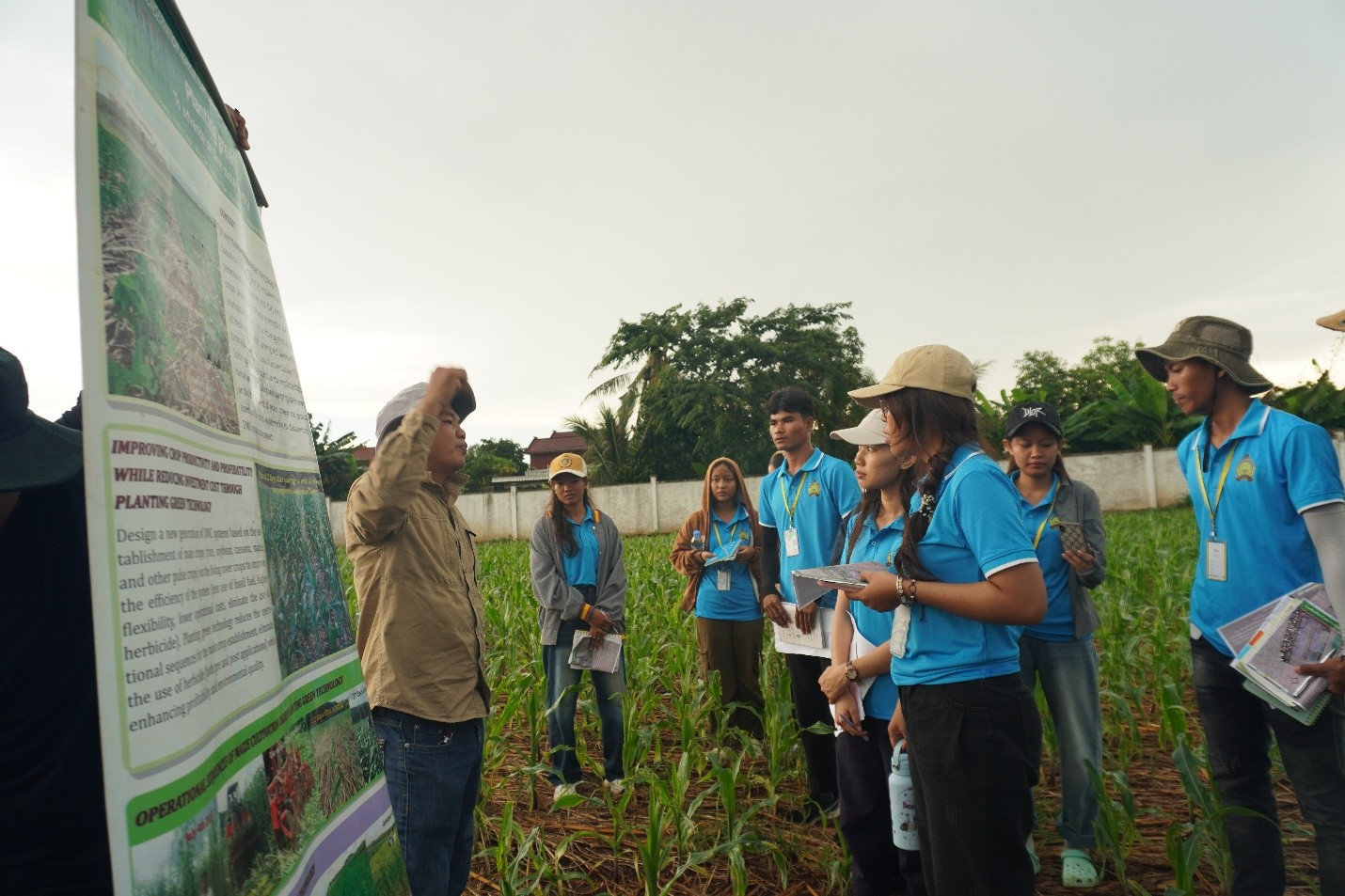
In a significant step to bridge academic knowledge with practical application, ALiSEA Cambodia recently organized a hands-on field exposure for agroecology students from the National University of Battambang (NUBB). The field visit, focused on “Conservation Agriculture and Cover-Crop Systems,” was designed to deepen students understanding of these crucial topics beyond the theoretical confines of a classroom.
Held on Friday, August 8th, 2025, the visit took place at the Cambodian Conservation Agriculture Research for Development Center (CARDEC) in Bos Knor, Chamka Lue District, Kampong Cham Province. The day was structured to combine conceptual learning with real-world observation in research fields.

The students’ learning journey began with an in-depth session that provided foundational knowledge on:
- The key concepts of Conservation Agriculture (CA) and the cover-crop system.
- The diverse varieties of cover crops, their specific functions, and the advantages they offer in agricultural systems.
- Practical usage of cover crops and best practices for storing seeds.
- The principles of integrated farming, with a focus on intercropping and rotation crop as a key production strategy.
Field Experience Engaging
The visit to the long-term CA research station was a highlight, allowing students to have a “fresh sight” of the physical appearances of various crops and cover crops they had only read about.


Mr. Ieng Vira, a researcher at the center, guided the students through the different research plots, explained the research results and significance of different practices and cover-crop varieties.
A particularly impactful moment was the demonstration on soil erosion. Students observed the experiment showing how different soil types respond to water flow. The side-by-side comparison of forest soil, pastureland soil, soil from a Conservation Agriculture plot, and soil from conventional tillage highlighted the critical role that conservation practices play in maintaining soil health and preventing erosion.


By facilitating direct interaction between students and researchers, and by providing a tangible link between classroom theory and field practice, this is strengthening next generation of agroecology practitioners with invaluable knowledge and experience. Within our pre-test and post-test result, these findings suggest that the exposure visit had a significant and positive impact on enhancing participants’ understanding of conservation agriculture.